
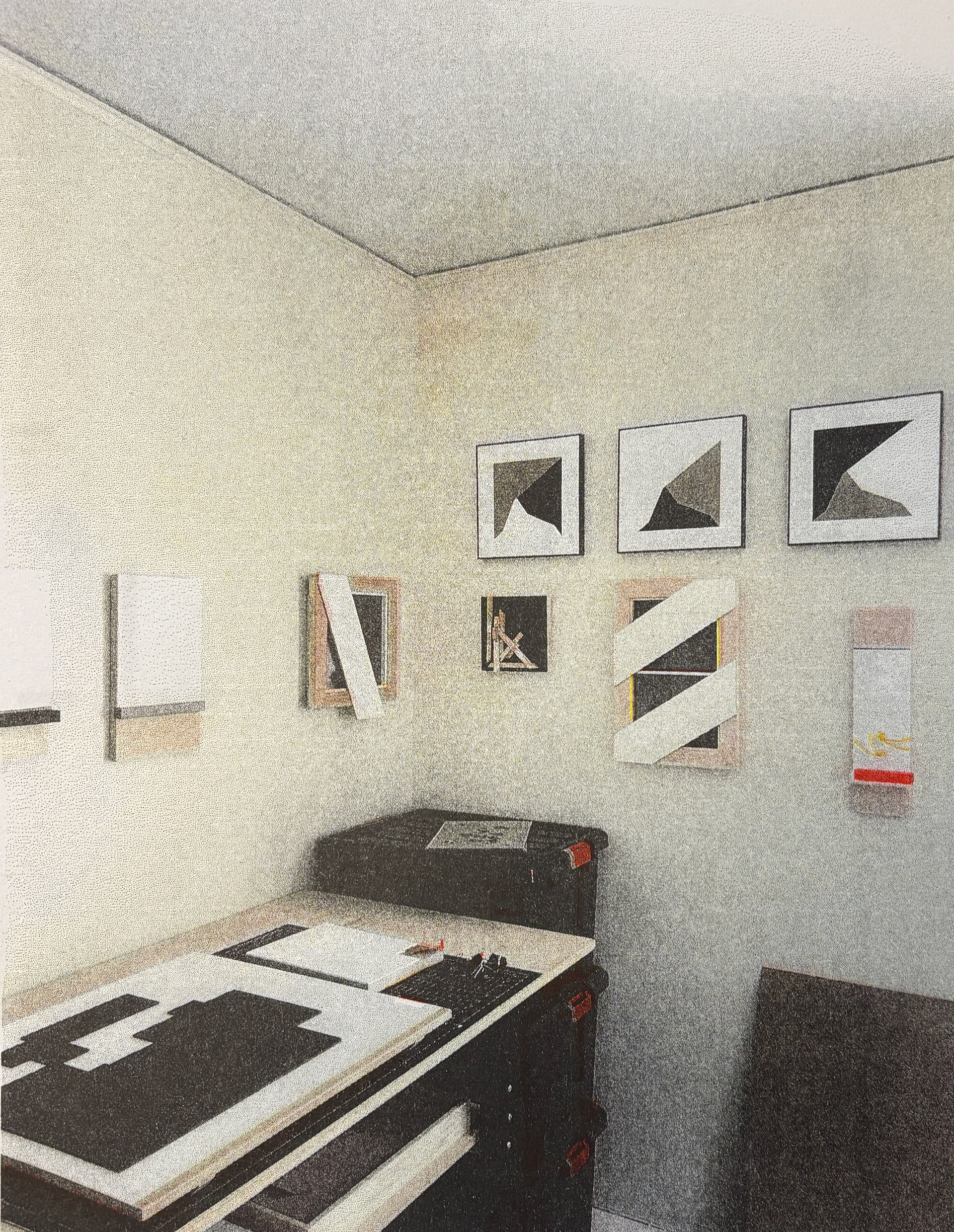
THE FOLLOWING QUOTATIONS HAVE BEEN PULLED FROM AN HOUR-LONG STUDIO VISIT WITH THE ARTIST, WITH MINOR EDITS MADE FOR BREVITY.
ON A DIY ETHOS
I am not educated or trained in anything. I am just self taught on everything,
I barely eked out high school, and then I played in a bunch of hardcore and punk bands in the 80s and 90s, and traveled and stuff. That whole DIY ethos has stuck with me.
I didn’t show my work until COVID, but I have been making stuff for decades.
I started by trading art with people overseas. I would just contact people and say: hey, I really like your work and I find it really inspirational, are you interested in trading?
I try to keep my price point low. It's important to me that my art works more as an aesthetic passport for me to meet people and navigate the world.
I never have the idea that I'll get any money from my work — that’s the furthest from my mind. But maybe that's because for so many years, I was doing it anyway. I've done every kind of blue color work. So if it doesn't work out, I'll just go back to doing that, I don't care.
ON SLOWING DOWN IN THE CREATIVE PROCESS
Pausing, stepping away, and focusing on cleanliness and order helps me to be reflective in my work.
I have noticed it really limits mistakes. I was making so many mistakes, and having to re-do things — because I would want to crank out new work, and I was in the zone. But that really didn’t work for me. The compulsion to make something would almost overwhelm me, and then the practical elements of doing the work got lost, and I wouldn't be happy with the end result.
I am always trying to transpose this optical sense of quietude in my work. But for a long time, this state of quietude wasn’t reflective in my process in the way that it is now.
ON CREATIVE PARAMETERS, INFLUENCES, AND ETHOS
I always work from a predefined set of parameters. Once the parameters are set, I keep subtracting and abstracting as I am building, so that my visual voice is as clear as possible.
It starts with the materials. And then in terms of color, I'm pretty much using greyscale, With hints of yellow and red.
De Stijl, Constructivism, Bauhaus, all the Scandinavian design – I'm very influenced by that stuff.
I make it a point that the front and back of a piece are just as important, even though most people won’t see the back. I think of the artworks more as wall objects.
ON THE PROFESSIONAL SIDE OF ART MAKING
Nothing was more helpful than trying to write my initial artist statement, because you don’t recognize how caught up in your own bullshit you are until you read it back to yourself. There’s so much that you recognize in that. It was so helpful for me, for my design, for everything.
In terms of a routine, it is really structured. In my previous jobs, there were always deadlines everyday, and that kind of stuck with me. It’s really helpful. So I always have my personal deadlines. Even for application submissions, I need to finish it two weeks before it’s due.
Having a deadline kind of snaps you into action. With anything creative, you’re kind of at the mercy of the creative compulsion, but there's so many other things to do besides making work: you have to be your social media person, your photographer, your PR…. you have to wear so many hats, it’s crazy. There’s always some kind of deadline.
There are so many people who are infinitely more talented than me, but if you can be that one artist who is good to go when someone drops out or something comes up, people remember that.